
The AI Capex Supercycle
Four companies plan to spend roughly $700 billion this year on AI infrastructure. History has seen this movie — twice — and both endings are instructive.
Bottom Line Up Front
The four biggest American tech companies — Microsoft, Amazon, Alphabet, and Meta — have guided to roughly $700 billion in combined capital spending for 2026, with analyst tallies running as high as $725 billion. That's up about three-quarters from last year, which was itself a record.
For perspective: that single-year figure rivals the inflation-adjusted cost of the entire U.S. interstate highway system — compressed into twelve months, funded mostly by four balance sheets.
The spending has outgrown those balance sheets. Free cash flow at these famously cash-gushing companies is compressing sharply, and the buildout increasingly runs on debt, joint ventures, and private credit — a structural shift that changes who holds the risk.
History offers two templates — the railroads and the telecom fiber boom. In both, the infrastructure won and much of the capital lost.
This report covers the aggregate wave — its size, its financing, and its kill conditions. The physical bottlenecks it's colliding with get their own reports.
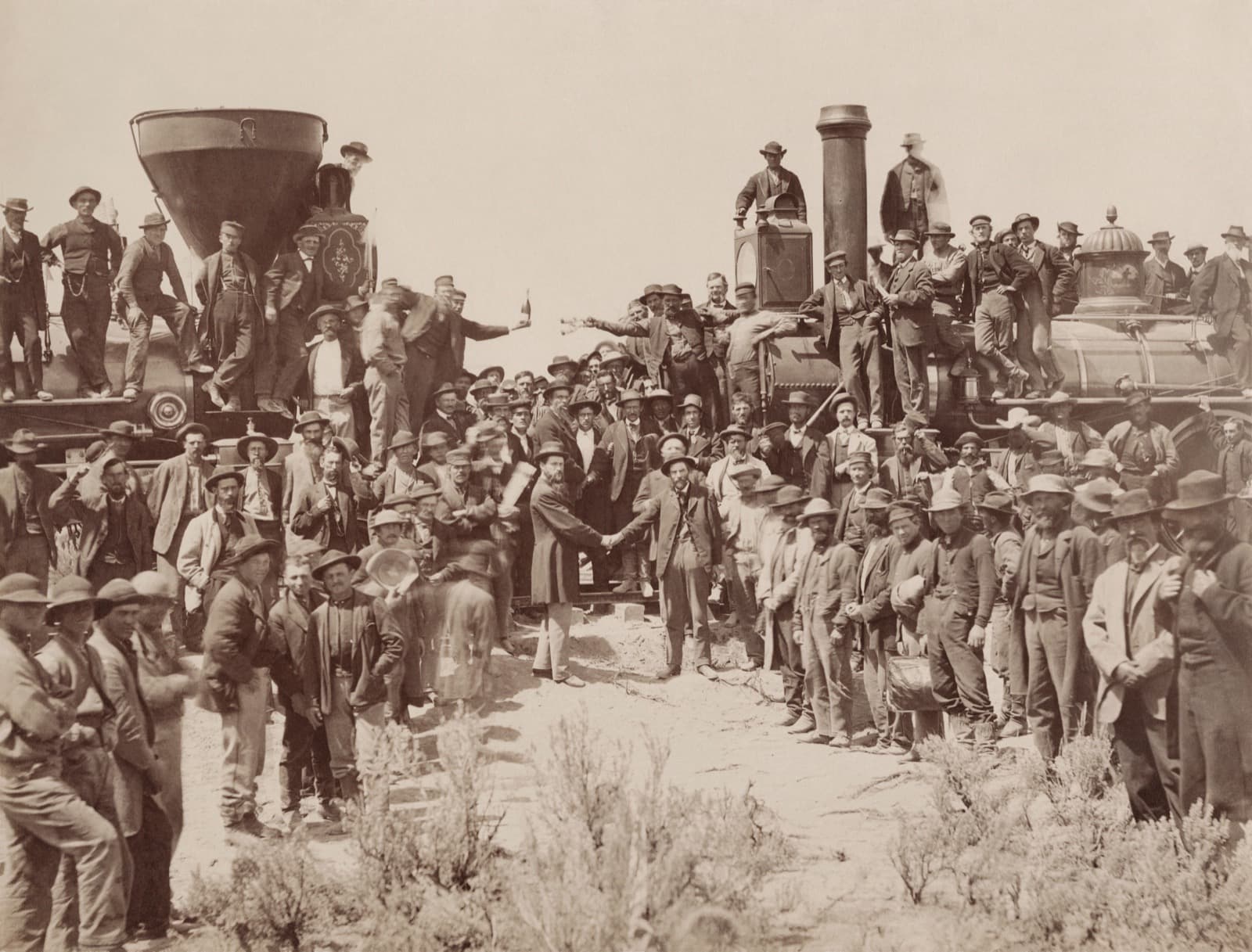
The photograph from Promontory Summit
Look at the image above this article. May 10, 1869: two locomotives nose to nose at Promontory Summit, Utah, crews shaking hands over the final spike of the transcontinental railroad. One of the most optimistic photographs in American history.
Here's what it doesn't show. Within four years, the railroad-financing house Jay Cooke & Company would collapse, triggering the Panic of 1873 and a depression. Over the following decades, railroad overbuilding would bankrupt a huge share of the industry's investors — even as the tracks rewired the American economy, created national markets, and paid civilization-scale dividends for a century.
Both things were true. The infrastructure was worth building; most of the people who financed it still lost their shirts. We've run the experiment twice — railroads, then 1990s fiber — and both times, transformative infrastructure and terrible average investment returns arrived together. A capex supercycle, translated: a period when an industry's spending on physical stuff grows so large it stops being a corporate story and becomes a macroeconomic force, bending interest rates, labor markets, and power grids around itself.
The numbers, and the plumbing under them
By that definition, AI qualifies. The 2026 guidance stack: Amazon around $200 billion, Microsoft around $190 billion, Alphabet in the $175–185 billion range, and Meta at $125–145 billion — raised mid-year, citing higher component costs. Add smaller players and the U.S. AI buildout now measures in the high hundreds of billions annually — meaningful percentage points of total private investment, and a visible share of GDP growth itself.
The more interesting story is the plumbing. Through 2024, this was self-funded — the safest capex in history, paid from software profits. That's ending. Free cash flow across the four is falling steeply even as earnings rise, and the marginal dollar increasingly comes from elsewhere: record bond issuance, and special-purpose vehicles in which private credit funds own the data center and lease it back. Meta's roughly $27 billion off-balance-sheet Louisiana campus financing is the template, not the exception.
Why does the plumbing matter more than the total? Because self-funded booms end with a shrug; borrowed booms end with a chain reaction. When the spending is someone else's lent money, a demand disappointment doesn't just trim one budget — it reprices credit for every project at once. That's the mechanism that turned railroad slowdowns into panics and telecom oversupply into a bond-market bloodbath.
Oak trees have mast years: every few autumns, seemingly in coordination, they produce a massive glut of acorns. Everything downstream feasts and multiplies. Then comes the lean year, and the populations built on glut math starve. Nature runs capex cycles too, and the danger isn't the feast — it's the ecosystem that grows to assume the feast is permanent. An entire economy of chipmakers, builders, turbine plants, and lenders is now sized to hyperscaler mast years.
So what would end it? Three candidates. First, the depreciation trap: hundreds of billions of short-lived chips generate enormous future depreciation charges, and if AI revenue grows slower than those charges arrive, earnings pressure forces cuts regardless of executive conviction. Second, physics: electricity and equipment constraints could throttle deployment no matter the budget. Third, one blink: in oligopoly spending races, the first major player to cut guidance re-anchors everyone's math in a single quarter.
Key Judgments
- Aggregate hyperscaler capex rises again in 2027, but the growth rate peaks by then — the shift from cash funding to debt and SPV financing is the tell that internal limits have been reached.
- The buildout is now macroeconomically load-bearing: a genuine spending halt would subtract measurably from U.S. GDP growth and hit credit markets, not just tech stocks.
- The infrastructure will outlive the boom that built it, echoing rail and fiber — but returns will distribute unevenly, favoring the scarce layers (power, land, chokepoint components) over the abundant ones.
- The cycle's end, when it comes, will be announced not by a crash but by one sentence of softened guidance from a single hyperscaler.
Risks & Counterarguments
The case that this time differs from rail and fiber is genuinely strong: these are the most profitable companies in history, funding much of the spend from operations; the capacity is substantially pre-leased to real workloads; and unlike dark fiber, compute depreciates and must be replaced, creating recurring demand. It's also possible we're early, not late — if AI agents deliver even a fraction of projected labor substitution, today's spending could look timid. The honest uncertainty: nobody, including the companies, knows the revenue curve that justifies or indicts these budgets. They're all betting ahead of the evidence, on purpose.
Why It Matters
You don't need to own a single tech stock to be exposed to this cycle. It's setting the price of electricity, the yield on corporate bonds, the backlog at industrial factories, and a growing slice of GDP growth itself. Supercycles socialize their consequences — that's what makes them super. Understanding the plumbing now is how you avoid being surprised by which pipe bursts later.
What We're Watching
- Quarterly capex guidance from the big four — especially any gap opening between announced plans and actual cash spent.
- Free cash flow trajectories and the share of buildout funded by debt and SPVs, visible in 10-Qs and bond issuance data.
- AI revenue disclosures versus rising depreciation schedules — the earnings vise, tightening or loosening.
- The first major project cancellation or asset sale by a hyperscaler, however quietly disclosed.
Sources: Microsoft, Amazon, Alphabet, and Meta 10-K/10-Q filings and earnings calls via SEC EDGAR; corporate bond issuance data; BEA private fixed investment series; historical rail and telecom financing literature. This is analysis, not investment advice.